Gambling Nerd’s Step-by-Step Guide to Building a Football Prediction App With ChatGPT
Ask ChatGPT who will win Liverpool’s next match an

Ask ChatGPT who will win Liverpool’s next match and you may receive a convincing explanation. Building an app that shows where its information came from, how it calculates a forecast and whether its predictions hold up is a more useful project.
You do not need to start with a complicated machine-learning system. A small browser app, a checked results file and a transparent calculation are enough for a first version.
This Gambling Nerd guide uses Liverpool against Brentford at Anfield on 25 August 2024 as a historical teaching example. The calculation uses the completed 2023/24 Premier League season. The match result stays outside the model until the review stage.
The interface previews below show the five stages of the example app. You can also football_prediction_lab.html, open it in a browser and inspect the calculation.
Step 1: Give ChatGPT a Specific Building Brief
Start with one fixture and one competition. Asking for a tool that predicts every league immediately creates unnecessary problems with data quality, team names and missing records.
Liverpool is a suitable example for A Football Report readers. The club appears across the publication’s coverage, including its analysis of Liverpool’s tactical development.
Use this opening prompt:
- Build a football prediction app as one HTML file with embedded CSS and JavaScript. Use five tabs: Setup, Sources, Dataset, Forecast and Journal.
- Begin with Liverpool at home to Brentford in the Premier League on 25 August 2024. Label this as a historical reconstruction created now, not a prediction published before the match.
- Use the completed 2023/24 Premier League season as the initial training window. Store source URLs, retrieval dates and research notes. Keep match outcomes used for evaluation separate from training inputs.
- Include CSV import, clear validation errors, a transparent goals-based model and a journal with JSON export. Save notes and journal records locally in the browser.
- Do not invent missing information, connect to bookmaker accounts or generate probabilities from written opinion. Explain how to save and open the HTML file.
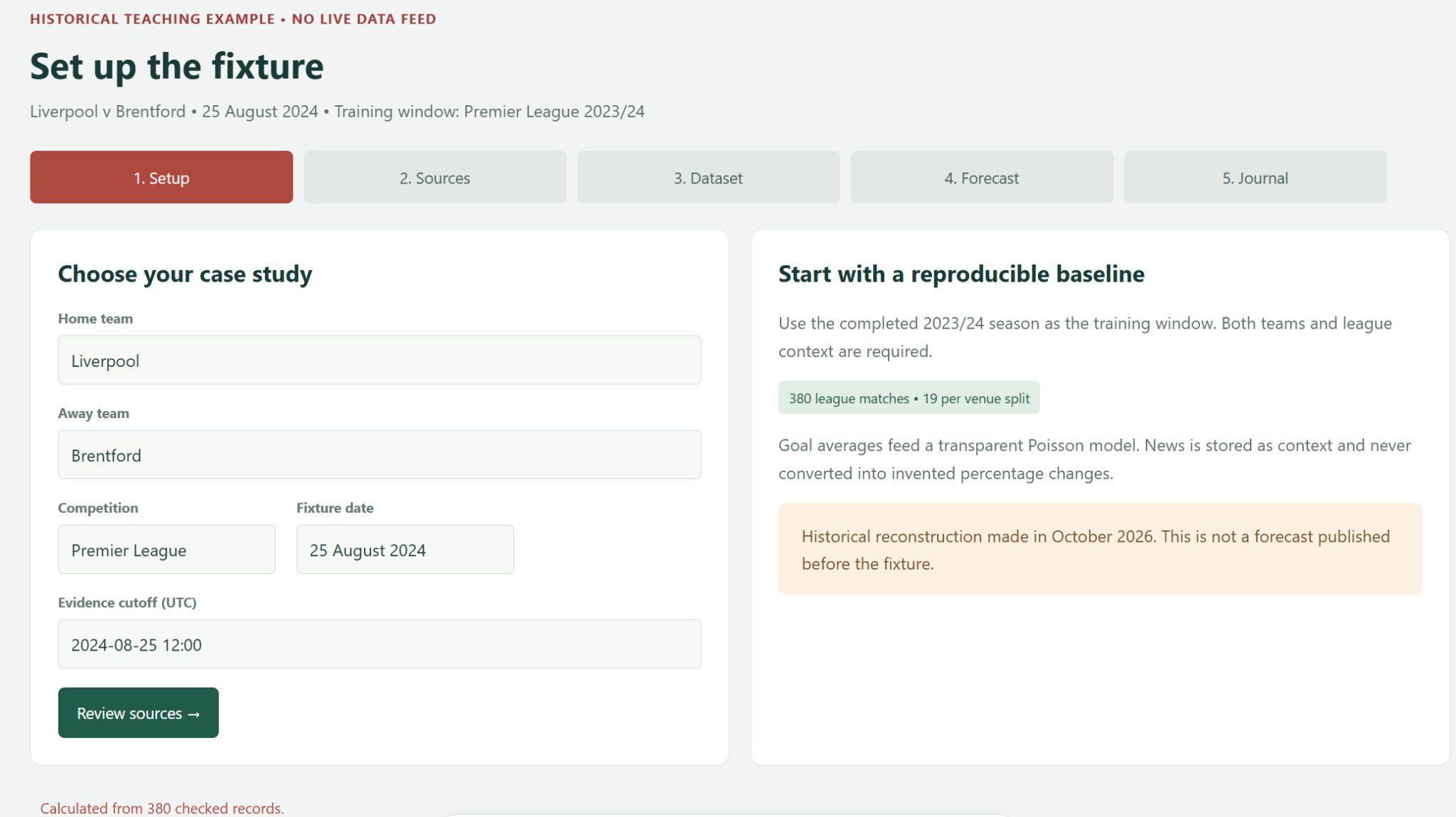
Setup screen: identify the fixture, evidence cutoff and training window before collecting information.
A single HTML file keeps the first version manageable. Save the code ChatGPT provides as football_prediction_lab.html and open it in a browser.
The app does not automatically inherit ChatGPT’s research capabilities. For this version, research happens in the conversation and checked information is imported into the app.
Step 2: Gather Public Information Without Mixing Facts and Assumptions
Football research needs boundaries. A search for Liverpool can return women’s fixtures, European matches, old injury reports and opinion pieces alongside current league information.
Specify the team, competition and dates:
- Research Liverpool’s and Brentford’s men’s first-team information for this case study.
- Locate the 2023/24 Premier League results dataset from Football-Data.co.uk. Record its URL and today’s retrieval date. Identify the fields Date, HomeTeam, AwayTeam, FTHG and FTAG.
- Separately identify official club or league sources for fixture details and team news published before 25 August 2024 at 12:00 UTC. Mark information you cannot reconstruct as unavailable. Do not interpret missing injury information as confirmation that everyone was available.
- Return an evidence table containing the fact, source URL, publication date where available, retrieval date and permitted use: model input, contextual note or outcome review.
- Exclude post-match reports from prediction inputs.
If your ChatGPT session cannot browse, supply the pages or download the dataset yourself. Do not accept invented citations as a substitute.
Football-Data.co.uk’s England archive provides downloadable season files. For this example, the 2023/24 Premier League file contains 380 completed matches. We use its results fields and ignore its odds columns.
The evidence inbox makes missing context visible and separates outcome information from model inputs.
The example deliberately leaves historical team news unmodelled. That is a limitation worth displaying.
For a future fixture, you could maintain a current news panel. Keep those notes separate until you have a tested method for translating them into numerical adjustments.
Step 3: Check the Dataset Before Calculating Anything
A polished dashboard cannot compensate for reversed scores or duplicated fixtures.
Ask ChatGPT to build the checks before adding more features:
- Add validation for imported CSV records.
- Require Date, HomeTeam, AwayTeam, FTHG and FTAG. Accept dates in DD/MM/YYYY or DD/MM/YY format. Reject invalid dates, missing teams, negative or non-integer goals, duplicate fixtures and matches after the evidence cutoff.
- Show the number of imported matches and the relevant home and away sample sizes. Preview several records for manual checking.
- Use only the five required fields. Do not insert missing scores or silently repair ambiguous records. Explain rejected rows.
For our downloaded dataset, Liverpool’s 19 home matches produced 49 goals scored and 17 conceded. Brentford’s 19 away matches produced 27 scored and 31 conceded.
Across all 380 league matches, home teams scored 684 goals and away teams scored 562. These are calculations from the results file, not figures generated by ChatGPT.
Check individual records as well as summary totals. A plausible average can still come from incorrect inputs.
Both teams matter. Liverpool’s scoring record alone cannot tell the app how likely Liverpool is to beat Brentford.
Keep competitions separate, too. A cup tie against different opposition should not quietly enter a Premier League-only baseline.
Step 4: Make the App Calculate Its Forecast
The first model should be simple enough to explain.
Our baseline compares each team’s venue-specific scoring and conceding rates with the corresponding league averages. It then uses a Poisson distribution, a mathematical model for counts, to estimate possible goal totals.
The model assumes the two teams’ goal counts are independent. Real football can violate that assumption: a goal, dismissal or tactical change can alter the match. This is a starting point for testing, not a complete description of the sport.
Give ChatGPT the exact calculation:
Implement this baseline without hidden adjustments:
- Liverpool’s model goal rate equals Liverpool’s home goals per match multiplied by Brentford’s away goals conceded per match, divided by the league’s home goals per match.
- Brentford’s model goal rate equals Brentford’s away goals per match multiplied by Liverpool’s home goals conceded per match, divided by the league’s away goals per match.
- Apply independent Poisson distributions to those two rates. Calculate score combinations from zero to 40 goals per team, sum them into home-win, draw and away-win probabilities, and normalise the totals.
- Display the inputs, sample sizes, goal-rate estimates and assumptions. Use full precision internally and round only for display. Block calculation when required inputs are missing or invalid.
- Label these as model goal-rate estimates, not provider xG statistics. Do not invent injury adjustments.
The inputs produce:
| Model output | Estimate |
|---|---|
| Liverpool goal rate | 2.338 |
| Brentford goal rate | 0.860 |
| Liverpool win | 70.4% |
| Draw | 17.5% |
| Brentford win | 12.1% |
The forecast shows its workings. The goal rates are model parameters, not a prediction that fractional goals will occur.
This baseline intentionally uses the previous completed season. It does not incorporate the opening match of 2024/25, changes in personnel or Liverpool’s change of head coach.
Those omissions make it unsuitable as a comprehensive match assessment. They also make the first calculation reproducible: readers can inspect the same inputs and obtain the same answer.
Before trusting the code, ask for checks. Identical team inputs should produce equal home- and away-win probabilities. Missing samples should trigger an error. The three outcome probabilities should total approximately 100%.
Step 5: Save the Forecast Before Reviewing the Result
The journal needs to preserve what the model actually said.
For a future fixture, save the probabilities before kick-off. For this historical example, record the current creation date and label it retrospective. An old fixture date must not become a fabricated prediction timestamp.
Use this prompt:
Add a prediction journal. Each snapshot must retain its actual creation timestamp, fixture, evidence cutoff, model version, numerical inputs and unrounded probabilities.
Keep recorded outcomes separate from prediction inputs. Allow journal export as JSON.
Explain how to evaluate forecasts across future matches using a multiclass Brier score: sum the squared differences between the three predicted probabilities and the outcome vector. State that lower is better under this convention.
Label the Liverpool–Brentford example retrospective. Do not describe it as a successful live forecast or use its result to tune the model.
Liverpool won the selected match 2–0, as confirmed by the Premier League’s match report. That report is used only at the outcome-review stage.
Using the model’s unrounded probabilities, the example’s Brier score is approximately 0.133 under the sum-of-three-squared-errors convention.
The journal separates the fixture date from the date the reconstruction was created.
One correct favourite does not establish forecasting skill. Gambling Nerd’s discussion of the difference between probabilities and individual results provides useful background: a likely outcome can fail to occur, while an unlikely one can happen.
For this project, evaluation means recording football forecasts. No wagers are needed.
Improve the App Through Testing
Once the baseline works, test it chronologically on matches it has not used for training.
Compare its probability scores with a simple reference, such as league-wide home-win, draw and away-win frequencies calculated from the same training period. A more elaborate model should earn its complexity by improving on that reference across held-out matches.
Possible later additions include recent-form weighting, larger historical samples and carefully sourced squad information. Change one component at a time and retain a separate test period. Repeatedly adjusting the model until it explains already-known results can make an unreliable method look impressive.
The same discipline applies to ChatGPT’s code. Check imports, calculations and saved records. Browser storage is not a backup, so export the journal regularly.
The useful achievement is an app that makes its evidence, assumptions and mistakes visible. That gives you something concrete to improve—and a better way to examine a football prediction than accepting a confident paragraph at face value.
About Gambling Nerd
GamblingNerd.com is an independent gambling media website publishing experience-based reviews, guides and analysis. Its Nerd Nook section explains probability, game mathematics and decision-making. Originally launched as gamblingsites.org in 2007, the site rebranded as Gambling Nerd in 2025.