Crypto Casino Games for Sports Bettors: From Keno to Crash Games
Sports bettors who move into crypto casino gaming

Sports bettors who move into crypto casino gaming often find themselves in unfamiliar territory. The mechanics are different, the pace varies wildly, and the math behind each game rewards a different kind of thinking. But for anyone already comfortable reading odds and managing bankroll risk, the shift isn't as steep as it might look.
This piece covers the main game categories that tend to attract sports bettors - what they offer, how they work, and what the actual experience looks like compared to a sportsbook.
Why Sports Bettors Drift Toward Casino Games
It probably starts with downtime. Sports seasons end, injury lists pile up, and there are stretches where the slate looks thin. Casino games fill that gap. But there's also something more structural happening: bettors who are already used to probability-based decisions tend to find number-driven casino games more approachable than pure slot mechanics.
Crash games and keno, in particular, give players a level of decision-making that feels closer to placing a bet than spinning reels. That said, the house edge still exists in all of these formats, and it doesn't shrink just because the interface feels familiar.
Keno: The Lottery Game That Rewards Pattern Thinking
How Keno Works in a Crypto Context
Keno is one of the older number-draw formats in gambling, and the crypto version doesn't change the core mechanic much. Players select a set of numbers - usually between 1 and 10 picks from a pool of 80 - and then a random draw reveals 20 numbers. Payouts scale based on how many of your chosen numbers match the draw.
What crypto keno adds is provable fairness. Most platforms using blockchain-based random number generation publish a verifiable hash before each draw, so players can confirm the result wasn't manipulated after the fact. This matters more than it sounds, especially for bettors who are already skeptical of unverified outcomes.
BetFury runs a version of keno that's fully on-chain in terms of its fairness verification. Their Bitcoin Keno game lets players adjust pick count and bet size before each round, which gives a degree of strategic flexibility that flat-rate keno doesn't. Experienced bettors tend to appreciate that kind of control over risk exposure, even if the underlying probability doesn't change.
Keno Odds and Pick Strategy
The relationship between number of picks and expected value in keno is non-linear. Picking fewer numbers reduces variance but also caps the top payout. Picking more numbers increases the ceiling but makes full matches statistically rare.
| Picks Selected | Approximate Hit Probability (1 match) | Top Payout Multiplier |
|---|---|---|
| 1 | ~25% | 3x-4x |
| 4 | ~23% (2+ matches) | 10x-20x |
| 8 | ~43% (3+ matches) | 100x+ |
| 10 | ~46% (4+ matches) | 1,000x+ |
(Probabilities are approximate and vary by platform rules.)
The key thing to understand is that keno is a negative-expectation game regardless of pick count. But the variance profile changes significantly, and bettors who prefer high-volatility outcomes - think moneyline parlays - might gravitate toward 8-10 pick configurations.
Crash Games: Where Sports Bettors Feel Most at Home
The Basic Mechanics
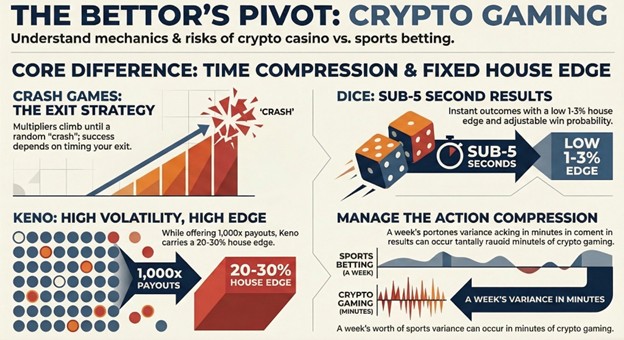
Crash games work on a simple premise. A multiplier starts at 1x and climbs upward until the game "crashes" at a random point. Players cash out before the crash to lock in winnings - or lose their bet if they hold too long. The multiplier can crash at 1.01x or keep climbing past 100x. There's no way to know in advance.
For sports bettors, this format has a familiar feel. You're making a decision about when to exit a position, which isn't entirely unlike live betting on a shifting line. The difference is that sports betting involves real-world information (form, injuries, momentum), while crash games involve no such signals - just probability and timing.
Risk Management in Crash Games
Auto-cashout is the most practical tool for disciplined play. Setting an automatic exit at, say, 1.5x or 2x means you don't have to make a manual decision under pressure. Bettors who struggle with in-play impulsivity often find auto-cashout helps them stick to a predetermined payout threshold.
What doesn't work is chasing losses through multiplier escalation - increasing bet size after crashes to "recover." The crash algorithm doesn't respond to betting history. Each round is independent. That's different from a sports market, where a line might genuinely move in your favor after new information.
Dice and Instant Games: Low Complexity, High Speed
Provably Fair Dice
Crypto dice is about as stripped-down as casino gaming gets. You set a target (roll over or under a chosen number), adjust the win probability, and place the bet. Higher win probability means lower payout. Lower win probability means a bigger multiplier.
The appeal for sports bettors is the directness. There's no narrative, no bonus round, no animation waiting to resolve. Outcome in under a second. This makes dice well-suited for bettors who want to pass time without deep engagement, though that same speed can make session management harder.
What "Instant Games" Actually Are
The "instant game" category in crypto casinos is broader than it looks. It includes dice, coin flip formats, wheel-spin variants, and card-based mini-games. Most share two features: fast rounds and transparent house edge. The latter is listed openly because provable fairness documentation makes it hard to obscure.
House edge in most instant games runs between 1% and 3%, which compares reasonably to the vig on a standard two-way sports market.
Comparing Game Formats: A Practical Overview
| Game Type | Variance | Round Speed | Skill Factor | Typical House Edge |
|---|---|---|---|---|
| Keno (10-pick) | Very High | ~30 seconds | Low | 20%-30% |
| Crash | High | ~10-60 seconds | Low-Medium | 1%-5% |
| Provably Fair Dice | Adjustable | Under 5 seconds | Low | 1%-3% |
| Instant Card Games | Medium | Under 10 seconds | Low | 2%-5% |
Sports bettors often underestimate how much worse keno's house edge is compared to crash or dice. The big multiplier potential makes it feel "worth it," but the math doesn't support that framing over volume.
Bankroll Considerations Specific to Crypto
Crypto-denominated games introduce a complication that fiat betting doesn't: asset price volatility. A session played in Bitcoin might look flat in BTC terms while the USD value moved significantly in either direction. Bettors who think in fiat terms need to decide whether they're tracking results in BTC or converted value - and stick with one.
Staking as a percentage of total crypto holdings rather than a fixed coin amount is probably the more stable approach. It mirrors standard bankroll percentage models from sports betting, just applied to a more volatile base asset.
What Sports Bettors Should Know Before Switching Sessions
The most common mistake isn't picking the wrong game. It's not adjusting session expectations. A sportsbook session might involve 5-10 bets over several hours. A crash or dice session can involve hundreds of rounds in the same time. That compression of action changes the psychological feel of variance, even if the math per-bet stays consistent.
And variance will happen fast. A 10-bet losing streak in sports feels like a bad week. A 50-round losing streak in dice takes about four minutes. Same statistical possibility, very different emotional experience.